Let’s be honest – some kids are just plain harder to love than others. But every child should be loved, and I live by the philosophy, “When they’re the hardest to love, love them the hardest.” From my parenting and classroom experience, here are the top five ways I’ve learned to love a difficult child.

**Links in this post may be affiliate links. This means that if you click that link and purchase the product, I may receive a small compensation. I am, however, committed to honestly assessing the products mentioned. Please read my disclosure policy for more details. **
If you have multiple children, chances are one of them is a bit more difficult to love than the others. (If you don’t have any kids, or you only have one, you’re probably thinking I’m awful for saying that, but if you have more than one kid over the age of 2, you know exactly what I’m talking about. 😉) Be honest: one immediately popped into your mind just now, didn’t they? (Side note: I’m going to continue to use “they” for simplicity’s sake. I do know the rules of grammar, but an abundance of he/she gets ridiculous.) Or maybe it’s not a particular child, but rather a particular season they’re in that makes them a little harder to love.
I have one child who, mostly because of personality differences, has always been more challenging for me to parent. Do I love him? ABSOLUTELY. Of course, I do. But it has required more conscious choice and intentional effort to love him well than my other two children.
And now that I’m getting more involved in the public schools (first as a volunteer and more recently as a substitute teacher), I’m interacting with all kinds of kids who – for various reasons – can be a bit more difficult to enjoy. But just as I love each of my own children unconditionally, I’ve made it my goal to love each and every kid I work with at school. Because every child deserves to be loved.
Whether it’s your own kids or those you work with at school, on the ball field, in ministry, etc., here are five game-changing (and heart-changing!) tips for loving a difficult child.
How to Love a Difficult Child
Some kids – whether because of personality differences, challenging behaviors, or tough seasons of development – are just plain harder to love than others. But I feel strongly that every child should be loved, and I live by the philosophy, “When they’re the hardest to love, love them the hardest.” From my parenting and classroom experience, here are the top five ways I’ve learned to love a difficult child.
IMPORTANT SIDE NOTE: I was really hesitant to use the label “difficult child.” I typically try to avoid labeling kids like that because it affects our attitudes towards them, which, in turn, affects the way they see themselves. Know that when I use it, there is an implied set of “” around each use of the word, and that what I really mean is “a child who presents behaviors, attitudes, or personality traits that are difficult for us to enjoy and/or discipline.” Since that’s quite a mouthful, however, I’ll simply say “difficult child,” hoping you understand my heart behind it.
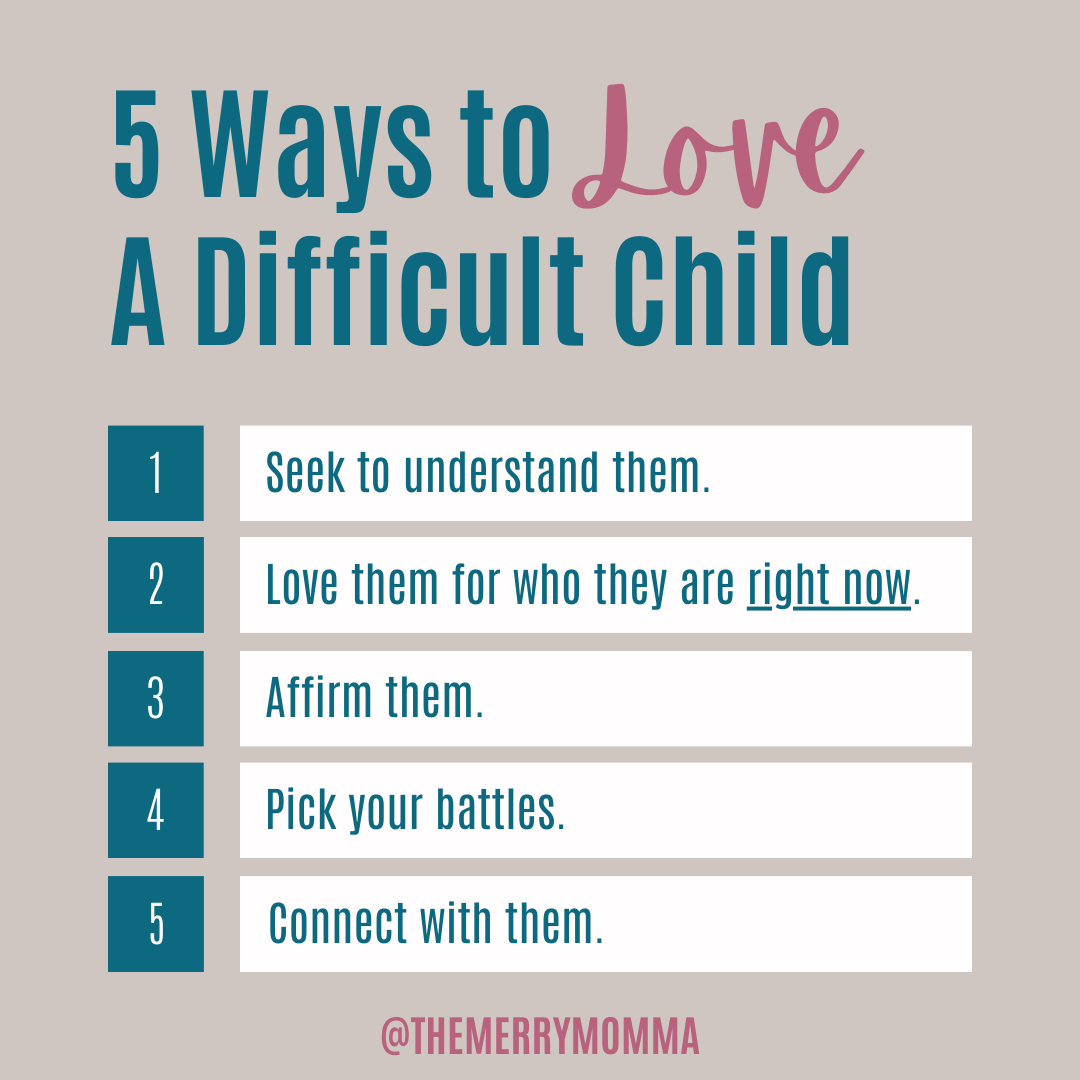
1. Seek to understand them
The first thing we should do to love a difficult child is dig to the root of WHY they feel so difficult to love.
Ask yourself these questions:
- Is it a personality difference between you and your child?
- Is it a tough season they’re going through – developmentally, emotionally, socially, academically, etc.?
- Is it certain behaviors that are especially challenging for you?
Figuring out why they feel more difficult for you to love is the necessary first step to guide your next moves.
If it’s a personality difference… then study up on their personality (and yours, as well)! Learn about what makes them “tick,” their natural inclinations and proclivities, how they make decisions, what motivates them, what’s challenging to them, etc. Learning more about their personality will help you understand them, which will help you accept them for who they are (more on that next) and love them for who they are.
If it’s a difficult season… then, first of all, shower them with grace and compassion! Put yourself in their shoes, find out more about what they’re going through, and seek information from trusted sources on how to best meet their needs. And remember that it’s just a season, and it will pass!
If it’s challenging behaviors… then keep asking “why?” until you get to the root of the behaviors. I truly believe that no kid wants to be “naughty” or “bad,” and no kid sets out to be difficult (not at first, anyway – it only becomes a deliberate choice after years of either learning that it gets them what they want or resigning themselves to “that’s just who I am.”).
Challenging behaviors are the result of a) not having the necessary knowledge or tools to act differently, b) unmet needs, c) conditioned responses to a stressor (or those unmet needs), and/or d) some other (often subconscious) attempt to communicate an internal struggle. So, don’t settle for “they’re just difficult.” Keep digging to unearth the reasons.

2. Love them for who/what they are RIGHT NOW
After you’ve sought to understand them, you can seek out appropriate solutions. Finding answers can be so rewarding (and a great relief!), but they rarely come quickly or easily. Even the best strategies and methods take time, and difficult behaviors don’t change overnight.
In the meantime, then, love your difficult child for who and what they are right now. Don’t wait to love on them if/when they meet your expectations, change their ways, or exhibit the behavior you want from them. Love them – actively and lavishly – right. now.
I can tell you from experience (not mine because I was a TOTAL people-pleasing rule-follower 🤣), kids who are constantly getting in trouble feel like garbage about themselves. They’re constantly asking, “What is wrong with me??” Eventually, they internalize the identity of being a “problem child,” and – either out of defeat or defiance – assume all the attributes of that role.
Instead of pushing difficult kids away, then, (which is often our natural reaction,) the best thing to do is to pull them in. Love them unconditionally. Connect with them on a heart level (more on that later).
Outward behavior comes from inward beliefs, and it’s extremely difficult (if not downright impossible) for kids to believe well of themselves when their hearts are damaged and broken.
Heal the hearts → strengthen the self-concept → correct the behavior. The longer I parent and the more I work with kids, the more I’m convinced this order is imperative.

3. Affirm them
Part of loving difficult children for who and what they are involves affirming what is good in them. (And I believe there is something good in every kid if/when you look hard enough!) There are many ways to do that, but here are five big ones:
Actively look for their strengths and point them out. As I said earlier, difficult children often develop an identity of worthlessness and failure. It is our job as their parents and adults in their lives to reverse that! Every single child has strengths, so look for those (even if you have to look really hard!) and point them out.
Reframe the difficult traits as positive ones. Many times, the difficult behavior or personality trait actually comes from a strength that’s coming out sideways. Try to reframe what you find challenging about your child as a positive trait. Then, make sure to speak that out to them and over them! They are probably not used to thinking or hearing about the positive side of their personalities, so help instill that vision and teach them how to use those strengths constructively.
Notice when they’re doing something good. Difficult kids are so used to getting in trouble, it becomes their identity. We need to help them form a different one. Watch for times they’re doing something good, and then remark on it.
Don’t praise or make a big deal about it (I’ll explain why in a minute); simply make an observation: “I noticed you hung your coat up/cleaned your room/helped your sister/got right to work when you walked in the classroom/followed my directions the first time/etc. I appreciate that, thank you.”
Help them be proud of themselves. It’s great to praise kids from time to time, but we want to be careful about how and how often we do it. For one thing, kids can quickly sniff out manipulation, and if they think we’re only praising them to get what we want out of them, it will produce the opposite effect. But also, we don’t want them to become dependent on our approval.
Rather than evaluate what they’ve done, describe it positively so they can credit themselves. Here’s one simple way I do this: rather than saying, “I’m so proud of you!” I say, “You must be so proud of yourself. You worked hard on that!” or ask, “How do you feel about [insert accomplishment here]?”
(This was a major paradigm shift for me, and I owe it all to the fantastic book How to Talk So Kids Can Learn — I can’t recommend it highly enough!)

Celebrate progress. Finally, we can affirm (and therefore love) difficult children by celebrating their progress. Don’t focus on how far they still have to go; emphasize how far they’ve come. Don’t nitpick at everything they’re still doing wrong; appreciate what they’re doing right.

4. Pick your battles!
As I’ve gotten to know the hearts of some difficult children, I’ve learned that they’re usually just as frustrated as we are. They often don’t know why they do what they do or how to do things differently. They often try to do better – temporarily, at least – but for a variety of reasons, struggle to do so. Eventually, they reach the point of resigning themselves to the belief that they can’t do better, and that’s when we get the defiance, rebellion, and indifference.
I’ve also learned that it’s incredibly demoralizing to be critiqued, chastised, and corrected all day every day. Especially when you’re confused about expectations, ill-equipped to meet them, or simply not developmentally ready to do so.
So, my next tip for loving a difficult child (and one I’m still learning to do well!) is to pick your battles. Especially in the early stages of retraining a behavior or response, resist the urge to correct everything. Learn to let some things go. Figure out what’s truly a non-negotiable issue that’s worth taking a stand over, and what’s simply a matter of your personal preference, pride, or convenience.

5. Connect with them
Finally (though this list is not linear, so you’ll be doing this concurrently with the other tips!), one of the best ways to love a difficult child is to make a concerted effort to connect with them on a heart level. Step into their world, get to know them and their interests, find out what they like and don’t like, etc.
I recently turned a huge corner in my relationship with my difficult child when I started taking a genuine interest in one of his latest hobbies. It’s a fascination I don’t particularly understand, and I had formerly merely tolerated it (at best). Seeing how much he loved it, however, I decided to dive in. I started asking him questions about it, learning about it, and even supporting it. He has been DELIGHTED by my interest. This particular pastime is going to be a temporary phase, but the connections we’re making will last a lifetime.
For more ways to connect with kids on a heart level, read my blog post, 5 Tips for Connecting With Kids.
Those are my best tips for loving a difficult child that I’ve learned over the last several years through experience and research. I hope they’ve inspired you to look at your own difficult child(ren) a little differently, encouraged you to approach them with compassion and care, and equipped you to love them well (even on the days they make you want to scream!). I’m deeply passionate in my belief that every child deserves to be loved for who they are, and I pray this blog post makes a difference in at least one child’s (and parent’s!) life.
YOU MIGHT ALSO LIKE:
- How My Challenging Child Made Me a Better Mom
- 6 Prayers for When Motherhood is Hard
- Managing Misbehavior: 6 Things You Need to Do
- How to Love Your Season of Motherhood

Share your thoughts!